
Observation shift
An Observation shift changes what the policy is shown. It perturbs the observation on its way from the task to the policy and leaves the state of the simulator untouched.
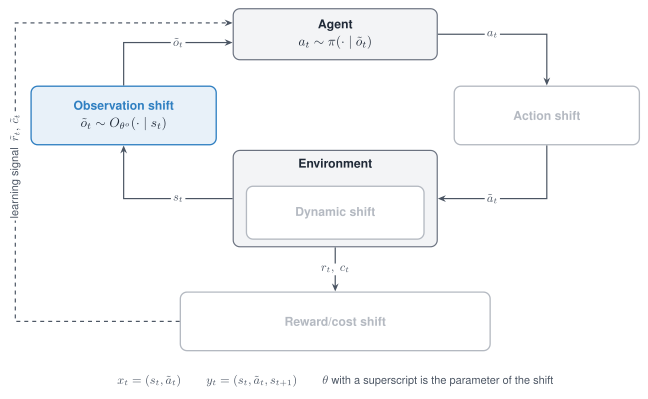
The Observation shift acts between the environment and the agent: the policy is shown a perturbed observation.
Properties
| Aspect | Observation shift |
|---|---|
| Perturbs | The observation returned by reset and by step |
| Target in code | observation |
| Modes | Stochastic, Adversarial, Parametric, Non-stationary, Composition |
| Observations | Arrays and dictionaries; the Adversarial mode needs an array |
| Acts on a frozen policy | Yes |
| Simulators | Any; the shift needs nothing from the simulator |
Supported modes
| Mode | Mode name in code | What it does |
|---|---|---|
| Stochastic | gauss |
Adds Gaussian noise with one standard deviation for all features |
| Stochastic | uniform |
Adds uniform noise from one interval for all features |
| Stochastic | relative |
Adds Gaussian noise whose standard deviation is a fraction of the scale of each feature |
| Stochastic | bias |
Adds an offset that is drawn once per episode, a sensor zero-offset |
| Adversarial | adversarial |
Searches a ball around the true observation for the point that changes the action of the policy the most |
| Parametric | shift |
Adds the same constant offset to every feature |
| Non-stationary | schedule on any of the six mode names |
Varies the noise level, the offset or the radius within the episode |
| Composition | Several shifts in one list | Stacks noise sources; a later shift sees the output of the earlier ones |
Parameters
| Mode name | Parameter | Type | Default | Meaning |
|---|---|---|---|---|
all but adversarial |
keys |
list of str | ["observation"], else all keys |
Entries of a dictionary observation to perturb |
gauss |
mu |
float | 0.0 |
Mean of the noise |
sigma |
float | 0.05 |
Standard deviation, in raw observation units | |
uniform |
low, high |
float | minus range, range |
Bounds of the noise |
range |
float | 0.1 |
Shorthand for a symmetric interval | |
relative |
frac |
float | 0.05 |
Standard deviation as a fraction of the scale of each feature |
ref_std |
list of float | None |
Scale per feature; without it, a running estimate | |
bias |
low, high |
float | -0.05, 0.05 |
Bounds of the offset |
sigma |
float | 0.0 |
If positive, the offset is drawn from a Gaussian instead | |
shift |
shift |
float | value, else 0.0 |
The offset |
adversarial |
eps |
float | 0.05 |
Radius of the ball, in the maximum norm and in raw units |
steps |
int | 10 |
Iterations of the gradient search; at least 1 | |
actor |
callable | None |
The policy, from a float32 tensor of shape [1, obs_dim] to the action tensor |
By default a goal-conditioned task keeps its goal entries intact: only the entry observation
of a dictionary observation is perturbed.
Declare the shift
from robustrllib import make_robust, ShiftSpec

HOPPER_STD = [0.16224, 0.06263, 0.20793, 0.28864, 0.61124, 0.81605,
              1.43574, 1.15449, 2.2949, 3.3575, 6.1127]

STOCHASTIC = {
    "gauss":    ShiftSpec("observation", "gauss", {"sigma": 0.05}),
    "uniform":  ShiftSpec("observation", "uniform", {"low": -0.10, "high": 0.10}),
    "relative": ShiftSpec("observation", "relative", {"frac": 0.05, "ref_std": HOPPER_STD}),
    "bias":     ShiftSpec("observation", "bias", {"low": -0.05, "high": 0.05}),
}
PARAMETRIC = ShiftSpec("observation", "shift", {"shift": 0.01})
The values of HOPPER_STD are those of the grid
robustrllib/configs/eval/part2_hopper.yaml.
Adversarial, with a small hand-made actor:
import torch

torch.manual_seed(0)
weights = torch.randn(3, 11)


def actor(obs):
    return torch.tanh(obs @ weights.T)


ADVERSARIAL = ShiftSpec("observation", "adversarial", {"eps": 0.05, "steps": 10, "actor": actor})
Non-stationary, with noise that grows over the first 500 steps of the episode:
NON_STATIONARY = ShiftSpec(
    "observation", "gauss", {"sigma": 0.1},
    schedule={"type": "linear", "start": 0.0, "end": 1.0, "t0": 0, "t1": 500},
)
Composition of a sensor offset and sensor noise:
COMPOSITION = [
    ShiftSpec("observation", "bias", {"low": -0.02, "high": 0.02}),
    ShiftSpec("observation", "relative", {"frac": 0.05, "ref_std": HOPPER_STD}),
]
The shift changes the observation and nothing else. The state of the simulator is read from the task for comparison.
import numpy as np

env = make_robust("Hopper-v5", shifts=[STOCHASTIC["bias"]], seed=0)
obs, _ = env.reset(seed=0)
offset = obs - env.unwrapped._get_obs()
obs, *_ = env.step(np.zeros(3))
print(np.allclose(obs - env.unwrapped._get_obs(), offset))
True
The offset of bias is the same at reset and after the step, and it is drawn again at the
next reset.
On a dictionary observation, keys selects the entries.
GOAL_TASK = ShiftSpec("observation", "gauss", {"sigma": 0.05, "keys": ["observation"]})
env = make_robust("PointMaze_UMaze-v3", shifts=[GOAL_TASK], seed=0)
obs, _ = env.reset(seed=0)
print(sorted(obs))
['achieved_goal', 'desired_goal', 'observation']
Rules
sigma, the bounds andepsare given in raw observation units.- An evaluation grid gives
relativearef_std; with the running estimate the noise depends on how many observations the wrapper has seen. - The Adversarial mode needs an actor before the first
reset; without one theresetraisesValueError. - The Adversarial mode is written for array observations; a dictionary observation raises
NotImplementedError. - The observation normalization of the policy belongs inside the actor, so that
epskeeps its raw units. - An Observation shift is listed after the Dynamic shifts of the same list.